

Introduction
You cleaned the counters, sealed the sugar, and sprayed that store-bought ant killer — yet somehow, the ants always return. Sound familiar? You’re not alone.
Across the U.S., ants are among the most persistent household pests, invading homes from spring through fall. But what makes them so relentless? Why do they seem to appear overnight — even in spotless kitchens?
Let’s uncover what’s really going on behind those tiny trails and how to stop the cycle once and for all.
1. The Real Reason Ants Keep Coming Back
Ants don’t just wander into your home by accident — they follow a plan.
When a single scout ant finds food, it leaves behind a pheromone trail — a chemical scent that tells the colony, “Food this way!” Within hours, hundreds of ants can follow that invisible path straight into your home.
Even if you wipe down the visible trail or kill a few ants, the colony still thrives outside, sending replacements again and again. Unless you eliminate the source — the nest itself — you’ll keep seeing new ants appear.
2. Common Entry Points You Might Be Overlooking
Ants can enter through the tiniest cracks — even gaps thinner than a credit card. Some of their favorite access points include:
-
Cracks in window sills or door frames
-
Gaps where utility pipes enter walls
-
Foundation cracks and weep holes
-
Unsealed baseboards and vents
-
Tiny spaces under flooring or tile grout
Tip: Try following an ant trail back to its source. Often, you’ll find a line disappearing under siding, behind an outlet, or near plumbing. That’s your clue where to seal.
3. What Attracts Ants Inside (Even in Clean Homes)
You don’t have to live in a messy house to get ants. They’re drawn by food, moisture, and shelter, which even the cleanest homes provide in small ways:
| Attraction | Common Sources | What to Do |
|---|---|---|
| Food & Sugar | Crumbs, pet food, sticky jars, spills | Store food in airtight containers, wipe surfaces daily |
| Water & Humidity | Leaky pipes, sinks, plant trays | Fix leaks, use dehumidifiers, empty standing water |
| Warm Shelter | Wall voids, baseboards, under appliances | Seal entry gaps, vacuum regularly, keep spaces dry |
Even one drop of soda or a few crumbs under the toaster can draw hundreds of ants overnight.
4. Why DIY Sprays Rarely Work
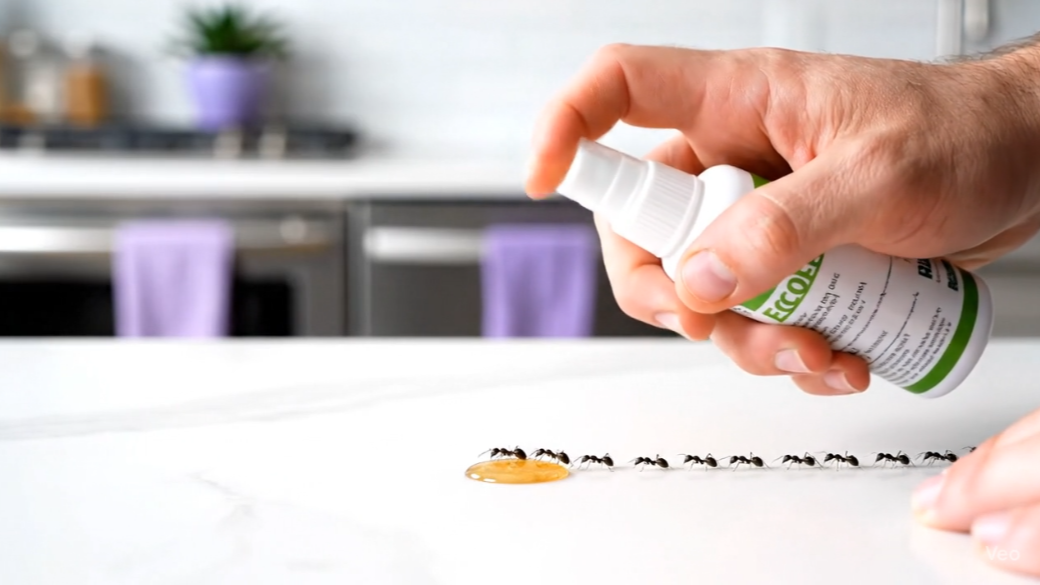
Most over-the-counter sprays kill visible ants — but not the colony.
When sprayed, ants release alarm pheromones, causing the colony to scatter and form new satellite nests. This makes the infestation seem to disappear temporarily… until it comes back stronger.
Professional pest control experts use targeted baits and non-repellent treatments that the worker ants carry back to the nest, wiping it out from the inside.
That’s why professional ant control is often the only long-term fix.
5. How to Keep Ants Out for Good
To break the cycle, combine exclusion, prevention, and proper treatment:
Step 1: Eliminate Attractants
-
Store all pantry goods in sealed containers.
-
Wipe down surfaces with vinegar or mild detergent (removes scent trails).
-
Rinse recyclables before storing them.
-
Keep pet food bowls clean and dry.
Step 2: Seal Entry Points
-
Use silicone caulk to close cracks and gaps.
-
Install weatherstripping under doors.
-
Replace damaged window screens.
Step 3: Target the Source (the Colony)
-
Use ant bait stations near entry points — not random sprays.
-
For larger infestations, hire a licensed pest control technician who can identify the species (carpenter ants, odorous house ants, pavement ants, etc.) and apply the right treatment.
Step 4: Maintain Regular Monitoring
-
Inspect every few weeks, especially after rain or seasonal changes.
-
Continue sealing, cleaning, and decluttering — prevention is ongoing.
6. When to Call a Professional
If you see ants in multiple rooms, flying ants (swarmers), or notice structural wood damage, it’s time to call a pro.
Carpenter ants, for instance, can weaken wood structures much like termites.
A professional pest control team will:
-
Identify the exact ant species
-
Locate all nests (including satellite colonies)
-
Use targeted baits and non-repellent sprays
-
Seal and monitor for long-term prevention
In the U.S., many pest control companies now use eco-friendly, low-toxicity methods, safe for kids and pets — proving that effective control doesn’t have to harm your environment.
Final Thoughts
Ants are small, but their colonies are mighty.
If they keep coming back, it’s not because you’re doing something wrong — it’s because they’re smart, organized, and persistent. The key isn’t to fight the ants you see — it’s to eliminate the ones you don’t.
A clean home, sealed entry points, and professional colony treatment together ensure that those tiny intruders finally get the message: Not welcome here.